


Mallorca is always a safe bet. Although you probably already know the island’s most famous destinations, today we want to tell you about a slightly lesser-known spot that’s well worth a visit: Colònia de Sant Jordi, a coastal town in the south of Mallorca that you’re going to love.
La Colònia belongs to the municipality of Ses Salines, which takes its name from the salt flats worked in the area since Punic times, and lies between Campos and Santanyí. It began life as a small fishing port and is now one of the most popular destinations in the south of the island, without having lost its relaxed atmosphere. Fancy discovering it from behind the wheel of your hire car in Mallorca? Here are our recommendations so you know what to do in Mallorca if you head to this part of the island.
What to see in Colònia de Sant Jordi
History and heritage
If you love history, the municipality of Ses Salines is a great place to discover the past of the largest of the Balearic Islands. Very close to the village of Ses Salines lies the Talayotic settlement of Els Antigors, a listed Site of Cultural Interest, with its impressive talayot of Sa Talaia Joana. Talayots are large stone towers built in the Bronze Age by the Talayotic culture, which developed in Mallorca and Menorca. There are other remains from the same period in the area, such as Es Mitjà Gran and the talayots of Na Mera.
Off the coast of La Colònia lies the islet of Na Guardis, home to the remains of an ancient Punic settlement, evidence of the trade that once linked this coast with the rest of the Mediterranean. And if you head to the village of Ses Salines, you’ll find the Torre de Ca’n Bàrbara in its main square, alongside some of its old windmills.
Beaches in Colònia de Sant Jordi
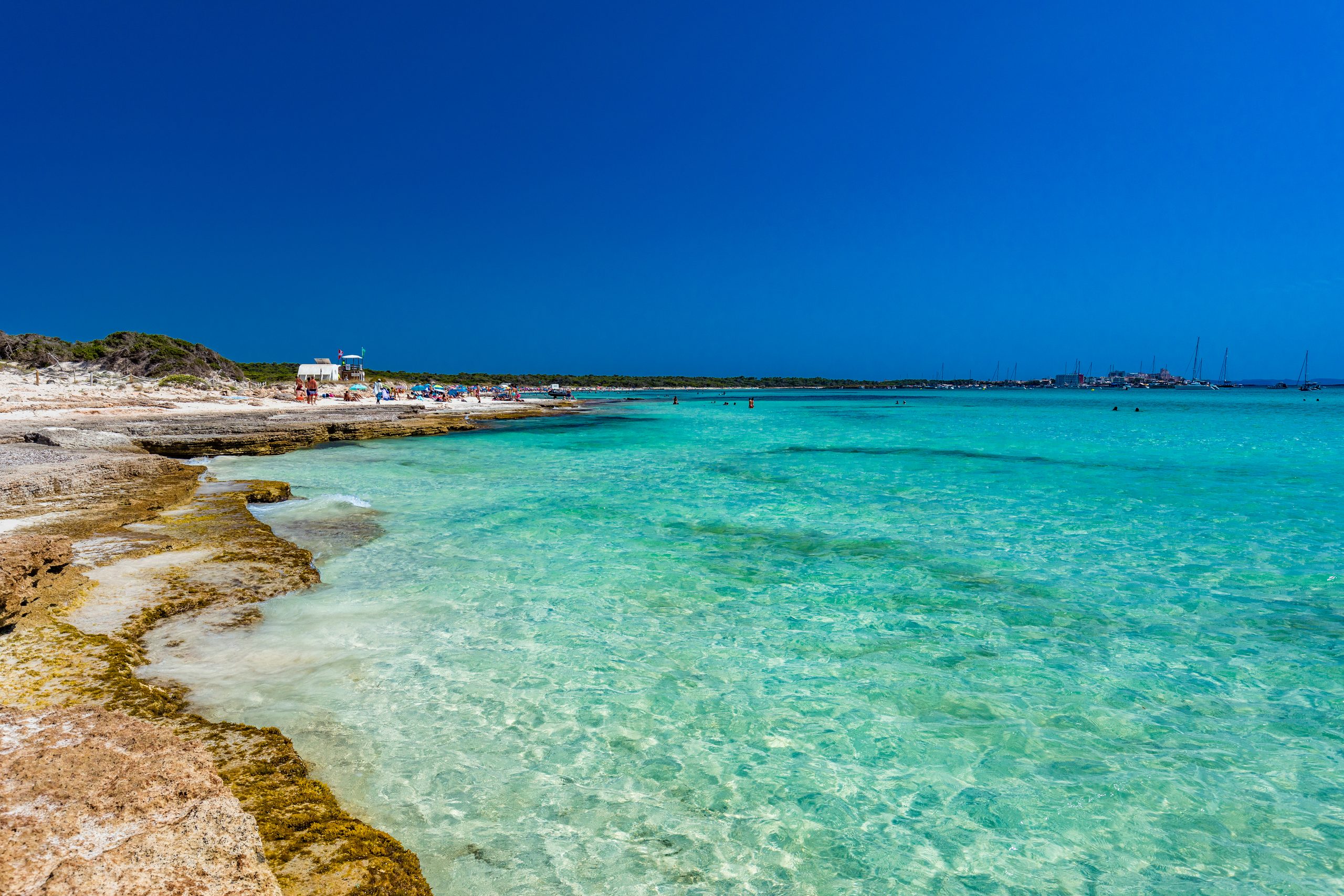
The town is surrounded by white-sand beaches and turquoise waters. Right in the town centre you have Des Port beach, next to the harbour, and Es Dolç, perfect for a swim without needing the car. Looking for somewhere quieter? Walk south along the coast, and you’ll reach Ses Roquetes and Es Carbó, a long, unspoilt beach of fine sand. If you feel like carrying on towards Cap de Ses Salines, the walk makes a lovely coastal hiking route, ideal in spring or at sunset.
Heading north, you’ll find the start of Es Trenc, one of the most famous beaches in Mallorca, with several kilometres of unspoilt sand inside Es Trenc-Salobrar de Campos Natural Park.
Market and festivities
If you’d like to take some typical Mallorcan products home with you, stop by the weekly market. There’s a market in the town on Wednesday mornings, and during the season there’s also an evening market on Tuesdays, with a real summer feel.
As for festivities, La Colònia celebrates its summer festivities between late July and early August. The programme includes concerts, sports competitions, the traditional duck release in the harbour, and plenty of activities for little ones, so it’s a great plan if you’re travelling with children. In April, around the 23rd, the town also holds its patron saint festivities in honour of Sant Jordi.
Excursions from Colònia de Sant Jordi
La Colònia also makes a great base for excursions around Mallorca and along its south coast.
Cabrera National ParkCabrera National Park
The boat trips to Cabrera, the area’s star attraction, leave from La Colònia’s harbour. They run daily during the season, roughly from spring to autumn. The Cabrera archipelago is part of the Cabrera Archipelago Maritime-Terrestrial National Park, one of the best-preserved natural areas in the Mediterranean, with exceptional marine wildlife and plant life. Most trips include free time on the island and a stop to swim in the Cova Blava, a sea cave with incredibly blue water. It’s one of the best family excursions in Mallorca.
Cabrera has plenty of history, too. In the Middle Ages, it was a refuge for pirates who raided the Mallorcan coast, which is why the castle that still watches over the harbour entrance was built in the 14th century. In the early 19th century, during the Peninsular War, thousands of French soldiers taken prisoner after the Battle of Bailén were confined on the island. The extremely harsh conditions and lack of supplies meant that many of them died, and a monument built in their memory can still be visited today.
Cabrera National Park Visitor Centre
If you can’t make the crossing, or want to prepare for it, visit the National Park Visitor Centre on calle Gabriel Roca s/n in La Colònia, the closest point in Mallorca to the archipelago. The building is inspired by the old watchtowers along the coast. Inside, an immersive route with an aquarium lets you discover Cabrera’s seabed, and the tower offers spectacular views of the coastline. It’s one of the most complete activities in Mallorca for children in the area. Bear in mind that it closes in December and January.
Es Trenc and Salobrar de Campos salt flats
The salt flats are another place you shouldn’t miss. Salt production began here in Punic times, around the 4th century BC, and carried on under the Romans, Byzantines, Arabs, and Christians right up to the present day. Salinas d’Es Trenc still harvests salt by hand, mainly in summer, and is open to visitors. In its shop, you can buy the famous flor de sal, one of the best food souvenirs from Mallorca. While you’re there, take the chance to explore Es Trenc-Salobrar de Campos Natural Park, a paradise for birdwatching, flamingos included.
Thermal waters of Sant Joan de la Font Santa
Just a few kilometres away, on the road from Campos to La Colònia, are the Sant Joan de la Font Santa baths, the only natural hot spring in the Balearic Islands, used since ancient times and declared of public utility in the 19th century. Today its waters feed the spa of an adults-only five-star hotel, which also offers thermal circuits to non-residents. It’s one of the most relaxing experiences in Mallorca you can treat yourself to.
How to get to Colònia de Sant Jordi
La Colònia is about 50 kilometres from Palma Airport, around 40 to 45 minutes by car. The most convenient way to get there, and to move between beaches, salt flats, and villages once you’ve arrived, is with a hire car. At ROIG, we offer car hire in Mallorca with collection at Palma Airport, so you can start your holiday as soon as you land. So, when are we off?