


Beyond the big tourist draws, such as the Serra de Tramuntana, declared a UNESCO World Heritage Site in 2011, Mallorca has plenty of other destinations that can win over any traveller. One of them is Porto Cristo, or Portocristo, a former fishing village on Mallorca’s east coast that belongs to the municipality of Manacor. Tradition has it that its name comes from a boat that reached this coast around 1260 carrying an image of Christ. If you’re wondering what to do in Mallorca beyond Palma, here’s our guide to what to see in Porto Cristo and the surrounding area.
With our hire cars in Mallorca, getting around the area is easy, and you can combine the village, its caves, and the nearby coves in a single day. When you land, our free shuttle bus will be waiting for you at the airport arrivals terminal. It will take you to our car hire office in Palma, in Son Oms, just five minutes away. From there, Porto Cristo is about 65 km away. If you’re already on the east coast, our offices in Cala Millor, Calas de Mallorca, Portocolom, and Cala d’Or are even closer. All hires include unlimited mileage, a free second driver, and free cancellation up to 24 hours in advance. And in our offers section, you’ll find cheap car hire options in Mallorca so you can explore the island without a care.
Places of interest in Porto Cristo
One of Porto Cristo’s main attractions is its setting, in a small south-east-facing bay that forms one of the largest natural harbours on the island. Despite modernisation, the village has kept its seafaring charm. Its town beach, around 300 m long, has fine sand, calm and crystal-clear water, and sunbeds and pedalos for hire. Boat trips along the east coast leave from the harbour, including glass-bottom boat tours. You can also go snorkelling or diving, or visit sea caves.
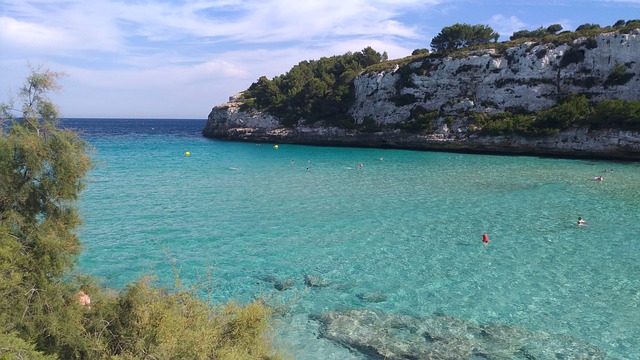
If you’re after something quieter, nearby you’ll find some of the best coves in Mallorca: Cala Magrana, Cala Anguila, Cala Mendia, Calas de Mallorca, Cala Murada, and Cala Varques, one of the most secluded spots in the area. Cala Petita is also very close to the village and can only be reached on foot, which makes it a good plan if you enjoy hiking in Mallorca. Take your pick!
The harbour is the real star of the village. Here you’ll find plenty of restaurants serving traditional Mallorcan dishes, with fish and paella ruling the menu. At one end of the bay, on the rock of Es Morro de sa Carabassa, stands the lighthouse, built in 1851.
If you like history, don’t miss the remains of the 4th-century Early Christian basilica of Sa Carrotja, or the traces of the Roman port beneath the present-day harbour. It’s also worth visiting the church of the Mare de Déu del Carme, patron saint of sailors, which began construction in 1890. The Torre dels Falcons rises on Avinguda Joan Servera Camps. Built in 1577 and standing 14 m tall, this watchtower was part of the network of towers that warned of approaching pirates. Today it offers superb views of the bay and features on the town’s coat of arms.
Festivities in Porto Cristo
Want to experience some of Mallorca’s liveliest festivals? Porto Cristo celebrates year-round. The most popular is the Mare de Déu del Carme, around 16 July. For several days there’s a night market, concerts, traditional music and dancing, a correfoc on the beach, and fireworks, as well as the maritime procession around the harbour.
The other big date is Sant Antoni, in January. Manacor is considered Mallorca’s capital of this festival, and Porto Cristo celebrates it with just as much enthusiasm. On the eve, the foguerons are lit, and the Goigs are sung, and on 17 January come the beneïdes, the parade of floats with the traditional blessing of animals.
The caves of Porto Cristo
Of everything there is to see in Porto Cristo, the Coves del Drach stand out. They’re an essential stop on any excursion route around Mallorca and among the most visited caves in Europe. The system is made up of four interconnected caves: the Black Cave, the White Cave, the Cave of Lluís Salvador, and the Cave of the French. Together they stretch for around 2.4 km and reach depths of up to 25 m, with a visitable route of almost 1,200 m.
The caves were formed by water from the Mediterranean seeping in, and some scholars date their origin to the Miocene. Their crown jewel is Lake Martel, around 115 m long and 30 m wide, one of the largest underground lakes in the world. It’s named after the French speleologist Édouard-Alfred Martel, who explored the caves in 1896. Every visit ends with a classical music concert performed by musicians on boats, after which you can cross the lake by boat. The visit lasts around an hour and is one of the experiences in Mallorca that most amazes young and old alike. It’s a good idea to book tickets in advance during high season.
One kilometre from the village, on the Manacor road, are the Coves dels Hams, another of the best caves in Mallorca. They were discovered by Pere Caldentey on 2 March 1905 while he was searching for onyx in the area. In 1910, they became the first caves in Spain to open to the public with regular tours, and from 1912 they had electric lighting, something pioneering for the time. Their name comes from the hook-shaped stalactites (hams in Catalan). The visit includes a botanical garden in an open-air grotto and a projection in the Blue Cave. It ends with a light and music show inspired by the Carnival of Venice over its underground lake, the Sea of Venice.
Right next door is Dinosaurland, a theme park that opened in 2022. If you’re looking for activities for children or planning a trip to Mallorca with kids, it’s one of the most complete family day trips in Mallorca: caves, dinosaurs, and beach all within a few kilometres.
How to get to Porto Cristo
The easiest way to get there is by road. From Palma, the Ma-15 takes you to Manacor, and from there it’s only about 12 km to the coast. Travelling by car gives you the freedom to stop at whichever coves you feel like and fit the cave visits around your own schedule. If you’d rather not drive, you can also book a transfer in Mallorca from the airport to your accommodation. Another option is our Premium chauffeur-driven car service in Mallorca. And if you fancy treating yourself, luxury car hire in Mallorca turns the drive through the island’s interior into part of the experience.
That’s our round-up of what to see in Porto Cristo if you decide to spend your holiday on Mallorca’s east coast. There’s only one thing left to do: book your car hire in Mallorca with ROIG’s rent-a-car service and start exploring. Or, if you prefer, book a Mallorca airport taxi for your transfers and make the most of your time in this town. Come and see it for yourself!